Translation by Reverso not verified

THE MARTYRS OF MORTEMER


Mado and Jean Vallat


The dramatic story of two teenagers
caught in the upheaval
of the Second World War


1939: The Approaching War

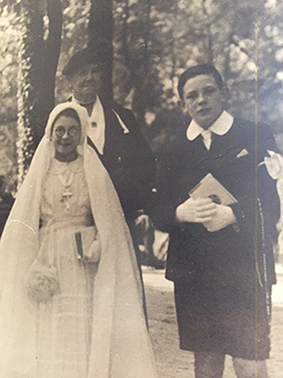
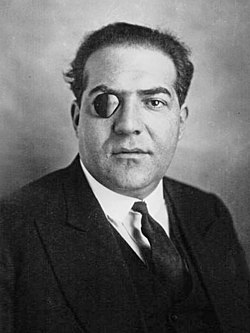
As summer 1939 approached, young Jean, 14, and Mado, 12, posed on the day of their solemn communion. The war seemed both inevitable and imminent. Does their slight smile hide their anxiety in the face of a war that would prove so cruel for them? Marc Vallat, their father, is a taxi driver in Paris. He and his brothers know Xavier Vallat. Aside from the last name, there is no other connection; Marc Vallat is from Angoulême, Xavier Vallat from Ardèche: it is impossible to find any trace of family ties. Jean Vallat was born in Paris on March 12, 1925, and his sister Marie-Madeleine, “Mado,” in 1927. Both children attend school in Paris and spend their summers in Lisors at their maternal grandmother Adrienne’s. Mado and Jean came into contact with Xavier Vallat fairly early. In 1937, the two children lost their mother to breast cancer. Their father, Marc, according to his own words, joined de Gaulle in 1940.The two children were then welcomed by Xavier Vallat (who had just been appointed Secretary for Veterans) and followed him to Vichy until 1942. Dolorès, Mado's daughter, asked her mother if she was afraid of Xavier, to which she replied, 'Not at all, kids, we were fascinated by his eye patch and wanted at all costs to lift it to see what was hiding behind it.' Mado was much more reserved about Xavier's wife, who had been obliged to take in the two children. After Xavier Vallat's political disgrace in 1942, the children returned to their maternal grandmother Adrienne, a remarkable woman! In June 1940, she had been stranded on the Mediterranean coast in the Free Zone. When this Free Zone disappeared in 1942, Adrienne crossed the occupied territories to retrieve her grandchildren.

Mado and Jean became motherless in 1939
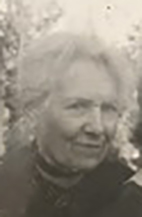
Behind Mado, her grandmother Adrienne


Maria Pauline Adrienne Lehideux (1864-1953), married name Briquet, was born in Ecouis in 1864. The daughter of a tinsmith, she received a solid education. At the time of her marriage in 1886 in Gaillarbois to Léopold Briquet, she declared her occupation as a milliner. The Briquet family was a good match. Her father was the mayor of Gaillarbois and worked for the railway company in Paris. The construction of the Gisors - Pont de l’Arche line in 1868 brought him to Gaillarbois, close to the important freight station in Ménesqueville. The young couple quickly moved to Paris. Adrienne was a strong woman, a confident personality who had practiced competitive fencing in her youth! She gave birth to a single daughter, Andrée, the mother of Mado and Jean, before becoming a widow in 1894.


1944, the Liberation and the End of the War

 
Jean Vallat settled permanently in Lisors in 1942 or 1943. He was employed as a lumberjack by Mr. Lesueur. He secretly joined the Resistance without his sister Mado or his grandmother knowing. In February 1944, the Resistance movements merged and became the FFI. He is listed in a record compiled after the war. It's difficult to know whether Jean was already a member of the ORA.
No armed actions are noted except for the one in Mortemer. On the evening of August 23, 1944, Albert Delacour, a member of the Rosay group of six, remembered being welcomed at the base camp by Jean Vallat, who was in charge of asking him the password "Mademoiselle Jeanne." Jean did not take part in the ambush at Fontaine Sainte Catherine. Early in the morning, the base camp was surrounded by the Germans accompanied by dogs. Lucky were those who managed to escape, some through the nearby ponds. He did not have that luck.

In the village, people are quickly warned about the German operation, but out of fear, they wait before heading into the forest to look for the missing.
.


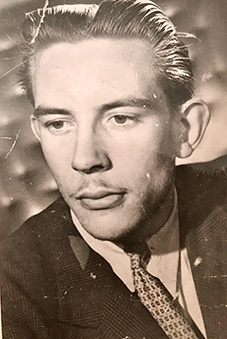
Jean VALLAT, 19 years old


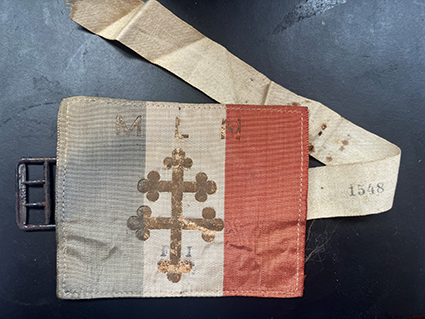
Jean Vallat's FFI armband retrieved by Mado

Testimony of Fernand Lebel in September 2004, living in Lisors, who had participated in the search for the bodies. He is the same age as Jean Vallat and a family friend.
"The search for the missing only begins two or three days after their disappearance, once the area has been liberated. Nevertheless, going out to search requires the utmost caution, as retreating Germans wander the forest with their weapons. The bodies are found fairly quickly, five days after the events."
The first five bodies were found on August 30 at 3 p.m., hastily covered with earth and leaves, very close to the Cross of the Shot. Four corps are together: Saquépée, Belliard, Schmitt and Vallat. They are in an advanced state of decomposition, naked, pierced with bayonet blows, their nails torn out, absolute horror. Guy Léon was separated from his four companions, alone, having been less martyred. It will be assumed that he must have buried his comrades. The men of the village came with a dumper. They will load the five bodies as best they can using straw. The heat on these days is strong.
The bodies will be deposited directly at the cemetery of Lisors. It is not known who will bring German prisoners from Mortemer in front of these corpses. The anger was such that they were threatened to be executed on the spot. These prisoners owed their salvation only to the intervention of a British officer. Henri Pétas and Gilbert Ouvry were discovered later, on 19 September. They were resting at the foot of a stump and it was an arm that protruded from the foliage that attracted attention. The bodies had not been tortured


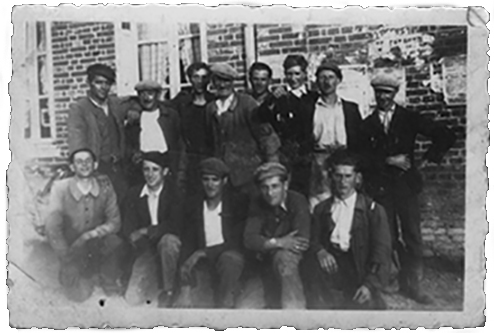
The loggers of Lisors in 1942
Jean Vallat is 17 years old, the third standing from the right.
To his left is Achille Saquépée and standing on the left, Guy Léon
(Jean is formally identified by his sister Mado)


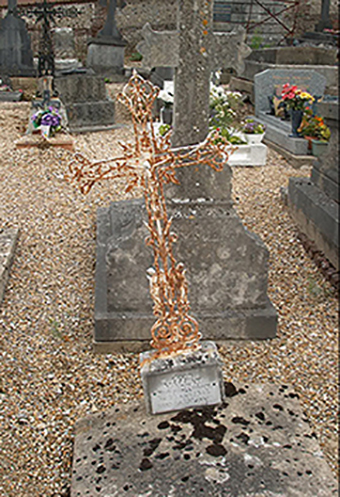
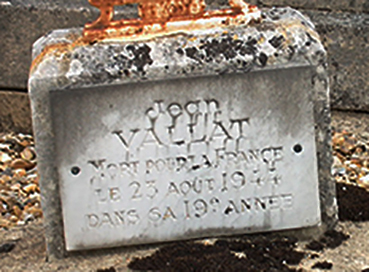
Jean Vallat's grave in 2004


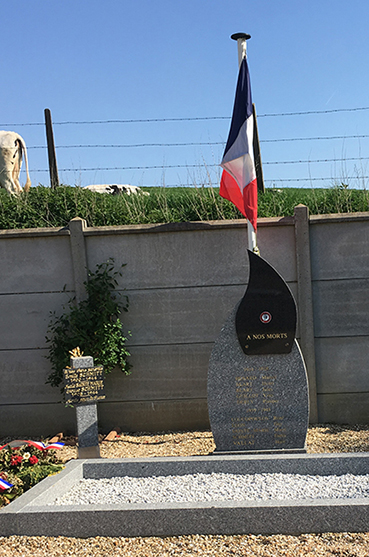
In 2018, the bodies were brought together in a single monument


Marie-Madeleine « Mado » Vallat 1927-2024


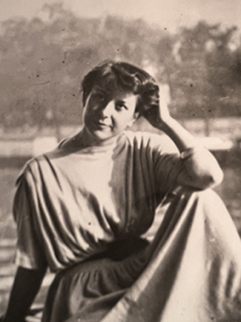
Mado spends her summers before the war in Lisors at her grandmother Adrienne's. She is friends with Emilienne Schmitt, who is going to lose her father, executed alongside her brother Jean. A week earlier, in front of her eyes, it was Emilienne's mother who was killed in a truck by the Allied air force. Upon her return from the free zone, Adrienne had to make do with accommodation in the outbuildings of a property near the crossroads, not far from the cemetery. The property is requisitioned by the occupiers, with officers in the main house and rank-and-file soldiers in the outbuildings. They burn and take away the furniture to build bunk beds, leaving Mado and her grandmother with only one room whose door they could not close!
In the main building lives the director of the Ménesqueville sawmill, Jean-Baptiste Cognard. How can one live in close proximity to the occupier without forming any bonds? On the evening of August 23, the German officer would advise J-B Cognard not to go into the forest (testimony from his son in 2025). He would only be briefly questioned during the liberation. Lumberjacks, to whom he gave sheep, would testify in his favor.
Shortly before the liberation, Mado leads the village children in singing American songs and saying "Welcome and Thank you" in English to the troops as they pass through the village. Her amusement comes from the fact that the soldiers passing through the village respond in French, as they were all French-speaking Canadians!

And yet, madness and excess will sweep everything away at the liberation. Village girls jealous of the little Parisian, boys struggling to accept that she isn't interested in them, a home sharing space with the occupier, an 'uncle' Xavier who is a major collaborator, it takes little more to make Mado a designated culprit.


She is taken to the cemetery where she discovers her brother among the five bodies that have just been found in the forest. She is asked to dig a grave that has been reserved for her! Taken to the Coisel crossroads in the company of other women, she will be shaved. It is unclear whether it was a local FFI tribunal or the Tribunal of Andelys, but Mado is sentenced to a ban from staying in Lisors on the grounds of "associating with the enemy." Mado and her grandmother are then hosted in Pitres by a cousin, Marguerite Bétille. Instead of listening to her grandmother asking her to be quiet, young Mado embarks on a letter-writing campaign detailing and complaining about the injustice of her treatment. Weeks later, there is a knock at her door, and the authorities of the new government take her away and imprison her. Her captivity will last a year; she mentioned having turned 18 on June 5, 1945, while in prison.She describes the establishment as a 'camp' rather than a prison, hosted by a farmer and his daughter. Mado stated that she never had a trial but was released abruptly and without warning on a cold night. At that time, her grandmother and father had to actively fight for her. She does not talk about her reunion. Her only comments concern the fact that upon her release and return to Lisors, she was turned away from the church. This did not bring her closer to the Catholic Church. This captivity haunted her all her life. She has always had strong opinions on political prisoners.

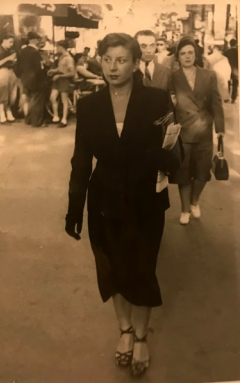
She then returns to Paris with her grandmother, reunites with her father, enrolls at the university to prepare for entry to the École Normale Supérieure, and wishes to pursue a career in journalism. Unable to find work, she takes on occasional photojournalism assignments. In 1954, at the age of 27, she boards the ocean liner Queen Elizabeth to cross the Atlantic to marry a tourist she met in Paris, Philip Kaplan, in New York.

Dolorès, her daughter, testifies as follows: "Mado was a proud Frenchwoman, known for her beautiful French accent, introducing French cuisine in the 1960s in a country that didn't know how to appreciate gastronomy, her beautiful home full of Norman treasures. She was a personality loved by all. She loved life and did not hesitate to share her story, a testament to profound kindness and the ability to overcome trials. I found a notebook where my mother took notes for small lectures she gave in local high schools about her story. We lived in a small town where there were not many foreigners, so she told an unknown story. Mado was resolutely anti-war and anti-gun her entire life."

Mado and her husband, a lawyer, will have three children, a boy and two girls. Mado will not adapt to American management methods and will not pursue a career. Her nights will sometimes be haunted by memories of the war.

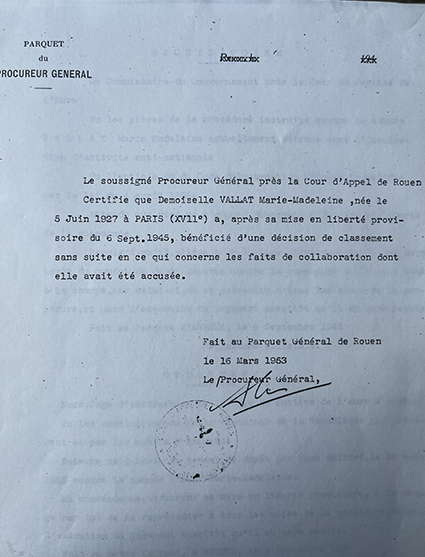
In March 1953, the Rouen Court of Appeal restored Marie Madeleine Vallat's honor.


Xavier Vallat (1891-1972)


Xavier is the tenth child of Cyprien Vallat, originally from Pailharès in Ardèche. A French teacher in 1911, his career was cut short by the war. Wounded twice, he lost a leg. His eye patch covers an illness, not an injury. Married in 1921, he would have no children.
Having become a lawyer, he joined and pleaded for Action Française. Anti-Semitic and anti-Freemason, he was considered the most formidable speaker of the right wing in the Chamber of Deputies. Nevertheless, he thanked Léon Blum for appointing women to his government and saw in it a sign of a law granting women the right to vote. Associated with the Vichy government as Secretary for Veterans, he took the helm in March 1941 of the General Commission for Jewish Affairs. Unpopular with the Germans, he was replaced by Darquier de Pellepoix in May 1942. From June to August 1944, he was on air at Radio Paris after the assassination of Philippe Henriot.Arrested at the time of liberation, he was sentenced to national indignity and ten years in prison in 1947. At the end of 1949, he was granted conditional release. At his funeral in 1972, Beate and Serge Klarsfeld, wearing a yellow star, were present at the church doors to remind people that he had been the first commissioner for Jewish affairs.

2019-2025, the duty of remembrance and research


Danielle Ferdon Vallat, Mado's granddaughter, is interested in the history of her great-uncle Jean Vallat. In 2019, at the University of Pennsylvania, under the guidance of her French professor Mélanie Péron, she chose this topic as the basis for a presentation in French. Initial contacts with me resumed in May 2025 with a visit from her mother, Dolorès. We will go to all the places of remembrance in Mortemer and Lisors. Mado's death in 2024 opened access to numerous documents preserved by her mother.

Jean Vallat maintained the anonymity of a name engraved in stone for 80 years. His young niece has shed light on all the horrors of war for two innocent teenagers. What a moving story!


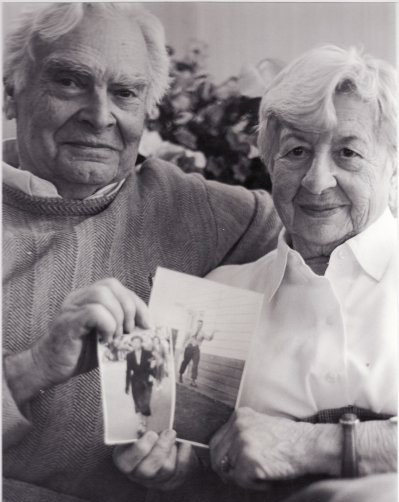
Mado et Phil Kaplan

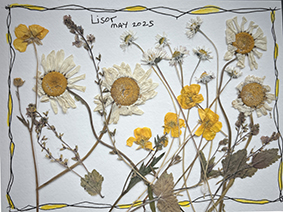
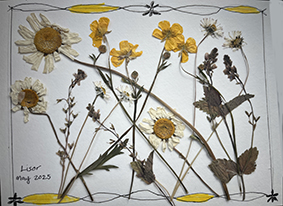
Spring flower herbariums made by Dolorès during her visit to France in May 2025, coming from San Francisco.
Dolorès gave them to her daughter Danielle.